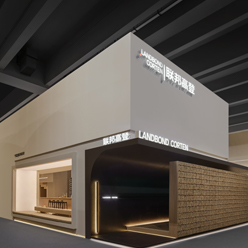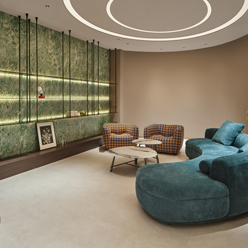
From Blank Canvas to Living Art: A Villa's Spatial Revolution.Every corner should have a sense of breathability, every piece of furniture should have a reason for its existence.
This seemingly contradictory demand—requiring both full functionality and extreme minimalism—became precisely the stage for the Landbond Corten team to demonstrate their professional depth. After months of deep collaborative creation, this villa has now completed its magnificent transformation from an "architectural shell" to a "living vessel." This article serves as the opening piece of a comprehensive case study series, fully revealing the design secrets of how custom furniture becomes the spatial skeleton, reshaping the soul of habitation.
Chapter 1: The Labyrinth of Needs and the Design Breakthrough
1.1 The Spatial Equation for Three Generations
Faced with a 260㎡ space, the Landbond Corten team first deconstructed the complex living needs:
Functional Matrix:
· Elderly generation
· Couple
· Children
· Public/Shared areas
Aesthetic Challenge List:
· How to avoid a cluttered feel?
· How to make 260㎡ feel warm and inviting rather than empty?
· How to unify the aesthetic preferences of different age groups?
· How to ensure minimalism is about "refinement," not just "simplicity"?
1.2 The Game-Changing Moment of Epiphany
Custom furniture is not decoration for the space; it is the structural body of the space itself.
Chapter 2: The Four Pillars of Design Philosophy
2.1 Pillar One: The Logical Revolution of Reverse Design
The traditional renovation process is: hard finishes completed → select furniture → add soft furnishings. Landbond Corten completely overturned this process in this case with an innovative design path.
2.2 Pillar Two: The Spatial Rhythm of Modularity
The team established a whole-house modular system based on a corresponding standard:
· All cabinet widths
· Unified door opening heights
· Precisely controlled skirting board heights
· Alignment of socket positions with cabinet partition lines
This mathematical precision creates a harmonious visual rhythm, allowing one to sense the beauty of order in the space even inadvertently.
2.3 Pillar Three: The Eastern Translation of Italian Minimalism
Landbond Corten did not simply copy Italian design but performed a deep localization translation.
Four Design Principles:
1. Structural Honesty
2. Visual Continuity
3. Functional Concealment
4. Light and Shadow Sculpting
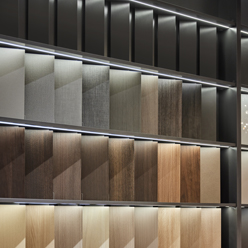
2.4 Pillar Four: The Philosophical Expression of Materials
The most groundbreaking aspect of the project lies in the three-dimensional narrative of materials:
· Temporal Dimension
· Tactile Dimension
· Cultural Dimension
Chapter 3: The Concrete Manifestation of the Spatial Skeleton
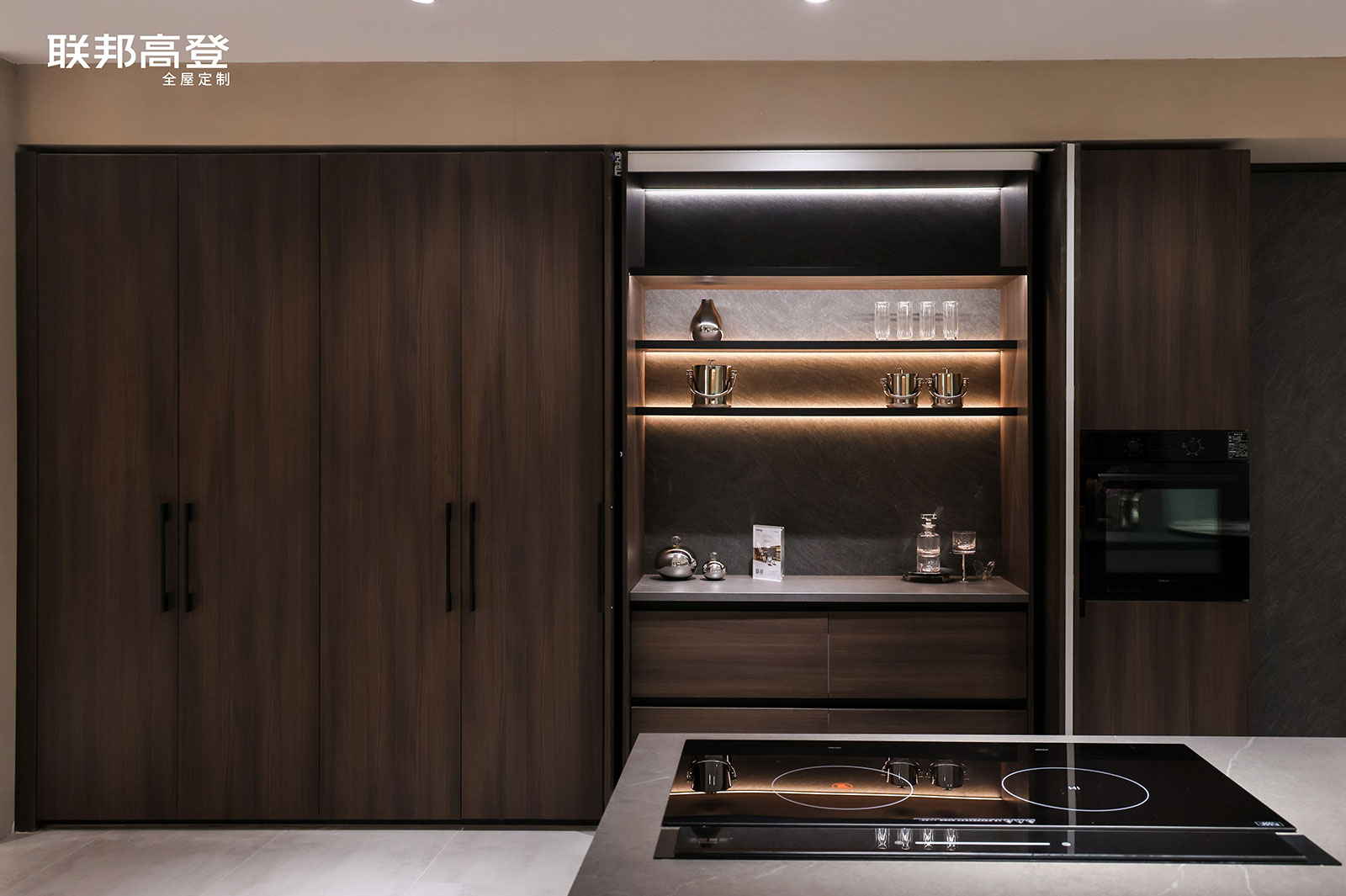
3.1 The Spinal System: The Wall-Door Integration Revolution
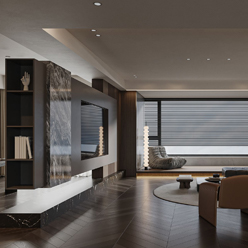
The main wall in the living room became the "spine" of the entire space:
· A continuous wall surface integrating a TV console, display shelves, and invisible doors
· A hidden lighting system creating a gallery-like ambiance at night
· A perfectly intact wall surface when all doors are closed
"This is not just a wall," but "the backdrop for the entire family's life, where all activities unfold naturally on this stage."
3.2 The Neural Center: The Whole-House Storage Network
A three-tier storage system:
· Primary Storage (Daily High-Frequency Use)
· Secondary Storage (Periodic Use)
· Tertiary Storage (Long-Term Storage)
Each storage unit is precisely calculated for frequency of use and ergonomic scale, ensuring "a home for every item, elegance in every action."
3.3 The Joint Connections: The Art of Invisible Transitions
One of the most important innovations in the space is the seamless transition technology between different materials:
These invisible details are precisely what constitutes the most valuable part of high-quality customization.
Chapter 4: Data-Witnessed Spatial Transformation
4.1 Quantitative Results Report
· Space Utilization Rate
· Storage Capacity
· Visual Extension Perception
· Cleaning Efficiency
· Energy Consumption Optimization
Chapter 5: Design Inspiration Transcending the Case Study
The greatest revelation from this 260㎡ villa project is: high-end customization is evolving from 'product delivery' to 'space construction.'
Landbond Corten demonstrated in this case:
1. Custom furniture can become the skeleton of a space, not just its muscle or skin.
2. The core of minimalism is systematic, not simply about reducing items.
3. Material innovation requires cultural depth; cross-boundary work needs philosophical grounding.
4. Good design is invisible service; what users experience is the result, not the process.
Conclusion: A Modern Interpretation of Spatial Soul
When the final piece of custom furniture was installed, and sunlight fully streamed into this 260㎡ space for the first time...
"The essence of a great space being like a poem—its form is exceedingly restrained, yet its (artistic conception) is infinitely profound"—was vividly realized.
This perhaps represents the highest realm of custom furniture: it is so crucial, forming the skeleton of the space; yet so humble, willingly serving as the backdrop, letting life take center stage. In the Landbond Corten case study, we see not just the customization of furniture, but the tailoring of a lifestyle, the deep awakening of a spatial soul.